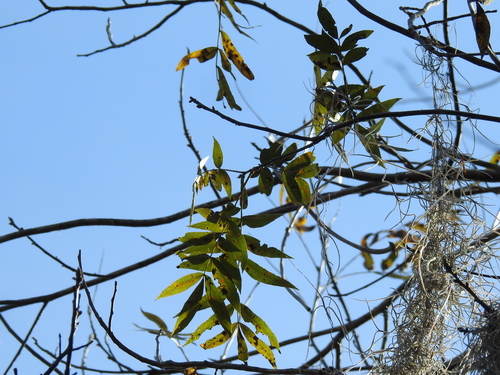
Trees, rarely shrubs , deciduous, with gray or brownish bark. Terminal buds larger than lateral buds. Leaves alternate [or opposite], aromatic, usually odd-, rarely even-, pinnately compound; stipules absent; petiole present. Leaflets 3-23, margins serrate or entire. Inflorescences: staminate catkins solitary or fasciculate, pendulous, elongate, on reduced shoots arising on branches of previous year or at base of current year's growth; pistillate catkins solitary or few-flowered spikes [or many-flowered racemes]. Flowers unisexual, staminate and pistillate on same plants; bract 1, bracteoles (0-)2. Staminate flowers: calyx 2-6-lobed or absent; corolla absent; stamens 3-50; filaments very short or absent; anthers usually pubescent. Pistillate flowers: calyx 4-lobed or absent; corolla absent; ovary 1, inferior, usually 2-carpellate, 1-locular distally; ovule 1; stigmas 2, fleshy or plumose. Fruits large nuts [or samaras], nuts enclosed in dehiscent or indehiscent, fibrous-fleshy or hard involucres (husks), thus ± drupelike. Seeds 1; endosperm absent; cotyledons fleshy and oily, variously lobed. The fruit in Juglandaceae superficially resembles a drupe, with a hard 'stone' surrounded by a soft, often fleshy husk. The husk, however, is not part of the fruit wall (it develops from the involucre and calyx), and the fruit is actually a nut (T. S. Elias 1972; W. E. Manning 1978). The morphology and classification of the family were discussed by W. E. Manning (1978). The female inflorescences and fruits show considerable variation in Latin American and Eurasian taxa.